1099-NEC vs 1099-MISC: 10 Compliance Requirements For Business Owners

Image credit: Freepik
When hiring independent contractors, business owners need to know the difference between the 1099-NEC vs 1099-MISC forms to ensure they report payments correctly to the IRS. Since 2020, the IRS has separated the reporting of non-employee compensation from other miscellaneous income to simplify the process.
Form 1099-NEC is for non-employee compensation paid to independent contractors, while Form 1099-MISC is for a variety of other miscellaneous payments, such as rents and legal settlements. Continue reading to understand these key differences!
The 1099-NEC: What It Is and Why It Matters
The Form 1099-NEC, or “Non employee Compensation,” is the form you use to report payments to independent contractors and service providers for services performed. Think of it as the counterpart to the W-2 for employees. If you paid a freelance graphic designer, a consultant, or a website developer $600 or more in a calendar year for their work, you need to file a 1099-NEC.
It’s important for you to know that starting 2026, the threshold increases to $2,000. For 2027 and beyond, the threshold will be adjusted for inflation annually.
For you, the business owner, it’s a critical part of ensuring accurate tax reporting and demonstrating your business expenses. Prior to 2020, this information was reported in Box 7 of the 1099-MISC, but the Internal Revenue Service (IRS) reintroduced the 1099-NEC to avoid confusion and create a separate, clearer reporting category.
The 1099-MISC: Its New Role
While the 1099-NEC took over reporting for independent contractors, the Form 1099-MISC is still very much in use. Its name, “Miscellaneous Information,” is a perfect description of its new purpose. You use it to report payments for a wide range of other types of income reported to non-employees.
The most common uses for the 1099-MISC are:
- Rent payments: For example, if you paid rent for an office space or a piece of equipment and the total was $600 or more, you would use this form. This includes rent paid to a property owner but generally not to a real estate agent or property manager.
- Medical and healthcare payments: Payments of $600 or more to doctors or other medical service providers as a business expense. This might include a company paid wellness program or specific healthcare payments.
- Legal settlements: Legal fees and legal services paid to an attorney generally go on the 1099-NEC for services performed, but gross proceeds paid to an attorney in a settlement agreement are reported on the 1099-MISC.
- Prizes and winnings: Payments of $600 or more for prizes and awards that aren’t employee compensation.
Knowing the difference between what belongs on the 1099-NEC and what belongs on the 1099-MISC is a fundamental step in being a compliant small business owner.
10 Compliance Requirements for Business Owners 📋

Image credit: Freepik
Understanding the forms is one thing, but knowing the rules for filing them is where compliance becomes key. Here are 10 compliance requirements every business owner should follow.
1. Know Your Due Dates 📅
The filing deadline for Form 1099-NEC is January 31st of the following year. This deadline applies to both providing a copy to the recipient (the independent contractor) and filing with the IRS. It’s a hard deadline with no automatic extensions. The due date for Form 1099-MISC, on the other hand, is March 31st if you are filing electronically, or February 28th if you choose paper filing.
2. E-File When Possible 💻
The IRS now requires electronic filing for most businesses. If you are required to file 10 or more information returns (this includes W-2s, 1099s, etc.), you must e-file. Even if you have fewer than 10, filing information returns electronically is generally faster, more secure, and helps ensure accurate tax reporting.
The IRS even has a free service called the Information Returns Intake System (IRIS) for filing information returns electronically. A transmitter control code is required for using the IRS’s e-file system.
3. Get a W-9 from Every Vendor 📄
Before you make a payment to a new independent vendor or service provider, you must get a completed Form W-9. This form provides their taxpayer identification numbers (TIN), name, and address, all of which are essential for properly completing your 1099-NEC or 1099-MISC form. Without a W-9, you risk filing an incorrect form and could be subject to penalties.
If a vendor refuses to provide a W-9, you are required to initiate Backup Withholding. This meas, you have to deduct a percentage from each of their payments and remit it to the IRS until they comply.
4. The $600 Threshold 💰
The golden rule for most 1099s in 2025 is the $600 or more threshold. You are required to issue a 1099-NEC or 1099-MISC if you have paid a non-employee $600 or more in the calendar year.
Even if you paid them in small increments that never reached $600 in a single transaction, if the total for the year exceeds the threshold, a 1099 is required. Starting 2026, the threshold increases to $2,000. For 2027 and beyond, the threshold will be adjusted for inflation annually.
5. Don’t Mix Up Employee and Contractor Payments 🔄
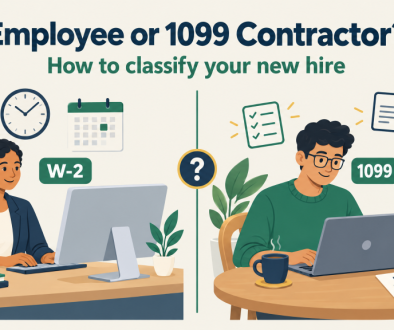
This may seem obvious, but it’s a common mistake. Payments for your W-2 employees are reported on Form W-2, not on any 1099 form. You are only required to issue a 1099-NEC for payments made to independent contractors and other self-employed individuals for services rendered. Misclassifying an employee as a contractor can lead to serious penalties from the IRS.
6. Collect the Correct Information 📝
To fill out the forms correctly, you need the recipient’s legal name, address, and Taxpayer Identification Number (TIN), which is usually their Social Security Number (SSN) or Employer Identification Number (EIN). You should collect this information from the W-9 and double-check it for accuracy.
7. Keep Your Records Organized 🗂️
As virtual bookkeepers, we can’t stress this enough! Maintaining clear, organized records throughout the year is essential. This includes keeping track of all non-employee compensation and other reportable payments you make.
Using accounting software like QuickBooks Online or Xero can streamline this process, making it much easier to pull the necessary data when it’s time to generate your tax forms.
8. Be Aware of State Requirements 🌐
Just because you’ve complied with the IRS doesn’t mean you’re in the clear with your state tax authority. Many states have their own 1099 reporting requirements, some of which may differ from the federal rules.
For example, some states may require you to file 1099-NECs even if the recipient is a corporation. Be sure to check your state’s specific rules, as failing to file can lead to additional penalties. If you used a vendor in a different state, you will need to check the regulations for that state.
9. Understand the “Direct Sales” Exception 🛍️
Direct sales of $5,000 or more of consumer products to a buyer for resale are reported on Form 1099-MISC. This is a niche but important detail, especially for businesses in specific industries. If you have this type of arrangement, you’ll report the income on the 1099-MISC instead of the 1099-NEC.
10. Stay Informed on Changes 📰
Tax laws and reporting requirements can change. The reintroduction of the 1099-NEC is a perfect example. The best resource for the most up-to-date information is IRS.gov. Regularly reviewing their publications and instructions for Form 1099-NEC and Form 1099-MISC is the best way to ensure you’re always in compliance.
How Florida Virtual Bookkeeper ®️ Can Help 🤝
Navigating the complexities of 1099 forms and other tax requirements can be overwhelming, especially for a busy business owner. At Florida Virtual Bookkeeper ®️, we specialize in getting your books “tax-ready”. We track W-9 forms and can assist with 1099 filing for our monthly bookkeeping clients.
We use powerful accounting software like QuickBooks Online and Xero to help you track and categorize every payment throughout the year. Let us make the process seamless so you can focus on what you do best: running your business.